About Dawn Meats
Do you know the ultimate winner of the 2025 World Steak Challenge? It is the Dawn Meats’ very own 32-day-aged Irish Angus striploin steak. The Irish company, founded in 1980, has grown into one of the largest meat processors in Europe, with facilities across Ireland, the UK, and Europe.
The challenge for Dawn Meats
Forecasting complexity
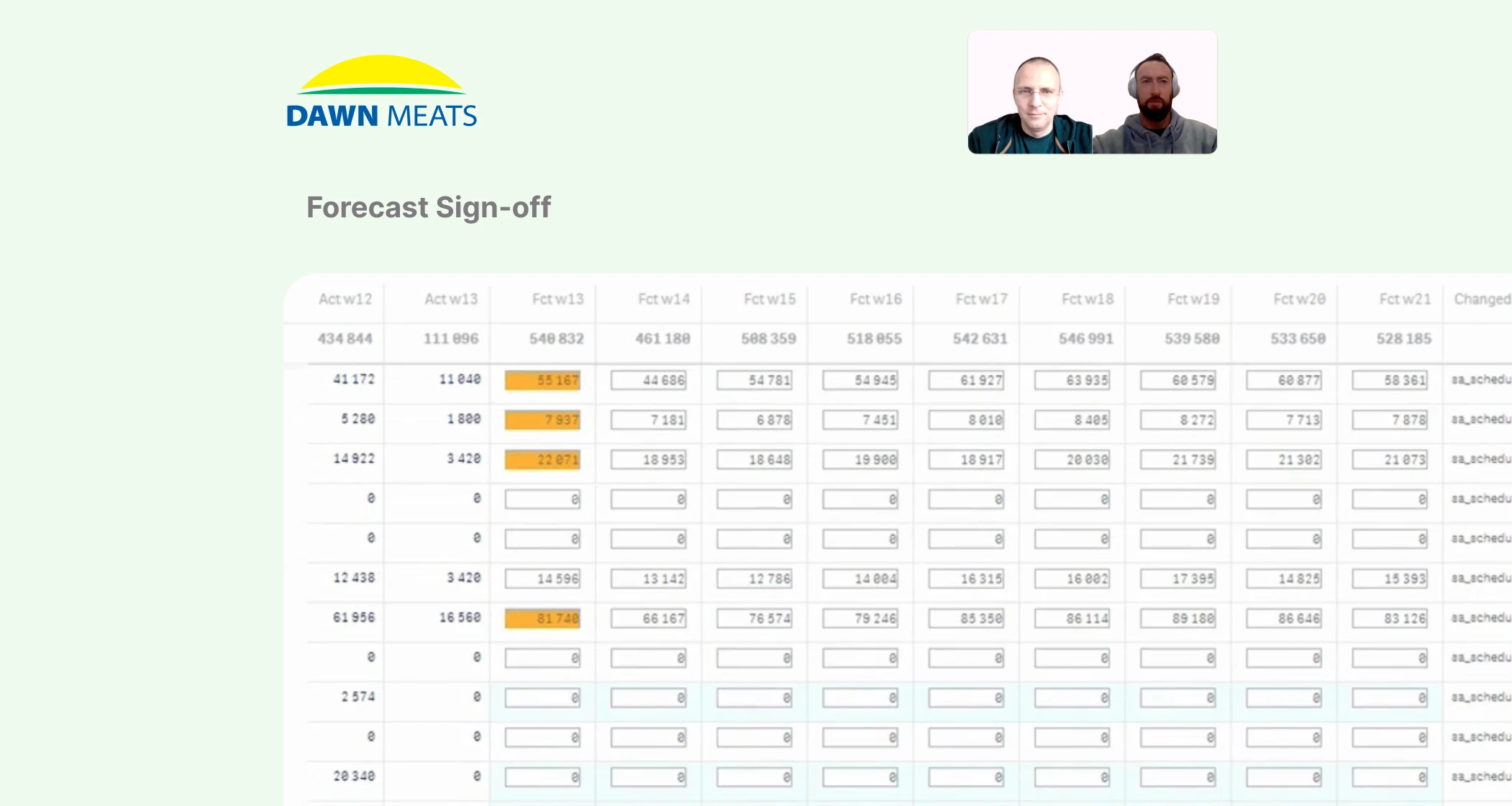
The sales forecasting project relied on a full spreadsheet-based system. The large files, which could contain 52 columns and 150 lines, were a “beast to get in and maintain“.
Yield pricing friction
The production evaluation process involved back-and-forth movement of multiple Excel spreadsheets between the finance and commercial teams.
Confidence gap
The use of disconnected tools meant the organization lacked a single source of truth, leading to low confidence in reported numbers and a low ability to make informed decisions.
Duplicated manual work
Finally, someone had to manually re-enter the data into the factory production system. That created a duplication of effort and a risk of error.
Combined, these issues created slow planning cycles, low confidence in the numbers, and far too much manual work.
How Inphinity helps Dawn Meats
Two workflows, two purpose-built applications. Dawn Meats built both in Qlik with Inphinity.
- The yield pricing app brings weekly production evaluation into one guided flow. Commercial enters price per kilogram directly in Qlik, the app draws supporting data from the ERP and factory systems, and built-in approvals carry each evaluation through commercial and finance sign-off. Every number is entered once and lands exactly where it belongs.
- The retail forecasting app does the thinking before anyone opens it. Python and Qlik’s native algorithms read sales history and weather data, then suggest a forecast for every product line. The commercial team reviews, adjusts, and approves, while recipe details feed straight into the primary forecasting system.
Together, the two applications gave finance, commercial, and operations one shared forecast they could trust and act on faster.
The impact was huge. The accuracy of the data reduced write-offs and drove measurable savings. With clear four-week forecast visibility, our planning teams can make better decisions across manpower, ingredients, labeling, packaging, and raw materials.
Brian Dunphy
Senior Project Manager – Business Intelligence
The Inphinity difference
Before
- Retail forecasting relied on large spreadsheets that were hard to maintain.
- Yield pricing depended on spreadsheet handoffs between finance and commercial teams.
- Key data had to be manually re-typed into factory systems.
- Forecast visibility was limited and planning decisions were reactive.
- Teams lacked one reliable number to work from.
After
- Forecasting models run automatically in Qlik using Python and native algorithms.
- Weekly production evaluation now moves through one structured flow with built-in approvals.
- Manual re-entry was removed from the process.
- Clear 4-week forecast visibility enabled proactive decisions.
- Commercial, finance, and operations now work from one shared forecast.
If you have a specific question about this case or you’d like to dive deeper into the solution, you can simply write to Simon.